
See a Demo
You're just one step away from seeing Call Loop in action.
Enter your information below to watch a demo right now.

You're just one step away from seeing Call Loop in action.
Enter your information below to watch a demo right now.


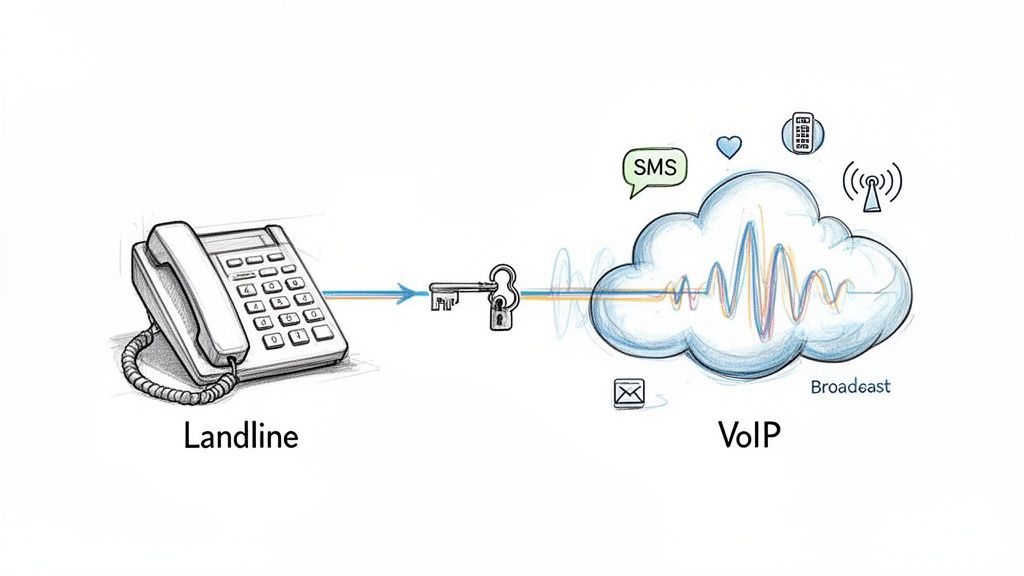
So, what exactly is a VoIP number? In short, a VoIP number means your business phone number runs on the internet instead of an old-school, physical phone line.
Think of it as a digital key that unlocks smarter communication, freeing you from the four walls of a physical office.
Let's cut through the jargon. A VoIP (Voice over Internet Protocol) number gives your business a voice that can operate from absolutely anywhere with an internet connection. It’s what lets you move from a manual, one-to-one communication model to a scalable, automated engine for growth. To really get it, you need to understand what a VoIP phone number actually means.
This one piece of tech is the foundation for some seriously powerful outreach tools. It's what allows you to:
This shift to VoIP isn’t just a small trend; it's a fundamental change in how business gets done. The global VoIP market is expected to jump from $144.77 billion in 2026 to a massive $326.27 billion by 2032.
That explosive growth is happening for a reason. Businesses are dropping expensive, clunky landlines for flexible VoIP numbers that can cut telephony costs by up to 50% and power multi-channel marketing campaigns.
A VoIP number unties your business from a physical location. It’s a flexible, powerful asset that moves with you, enabling sophisticated marketing and sales automation from anywhere.
Essentially, a VoIP number is more than just a way to make and take calls. It’s the control panel for your entire outbound communication strategy.
To make it even clearer, here's a quick breakdown of how VoIP stacks up against the traditional landline you're used to.
| Feature | VoIP Number | Traditional Landline |
|---|---|---|
| Foundation | Internet Connection | Physical Copper Wires |
| Location | Anywhere with Internet | Fixed to One Address |
| Scalability | High (Add lines instantly) | Low (Requires technician) |
| Advanced Tools | Ringless Voicemail, SMS | Basic Calling, Voicemail |
As you can see, the difference is huge. One is built for the past, and the other is built for the flexible, digital-first way we work today.
So, how does a VoIP number take your voice and shoot it across the internet like an email? It sounds complicated, but the concept is actually pretty straightforward.
Think about shipping a large, fragile painting. Instead of putting it in one giant, risky crate, you’d be much better off cutting it into numbered puzzle pieces, packing each one securely, and mailing them separately.
VoIP does the exact same thing with your voice.
When you speak into your phone or microphone, the VoIP system immediately chops up the sound waves of your voice into tiny digital bits of information. These bits are then bundled into small packages called data packets.
Each packet is like one of those puzzle pieces—small, numbered, and ready for a quick trip across the internet. At its heart, this is what a VoIP number does: it turns sound into something the internet can easily handle.
This method of breaking down and reassembling information is incredibly efficient. It allows your voice to travel over the same networks as emails and websites without needing a dedicated, old-fashioned phone line.
This shift from analog to digital is fundamental to modern communication. It's a key part of the evolution of call centers from traditional phone lines to digital hubs. This technology is also what makes features like ringless voicemail possible, since it's all about delivering audio data directly where it needs to go.
Two key players make this all happen behind the scenes, almost instantly.
When all the packets arrive at their destination—which happens in milliseconds—the device on the other end uses its codec to put the puzzle back together in the right order.
The result? You get a clear, seamless conversation, all powered by your internet connection.
Okay, so now you know how your voice magically zips across the internet. The next logical step is picking the right kind of VoIP number for your business. This isn't a one-size-fits-all situation; the best choice really boils down to what you're trying to accomplish.
Making a smart choice here is what separates the businesses that just use VoIP from those that truly profit from it. This flexibility is what allows platforms like Call Loop to power personalized drip sequences across both SMS and ringless voicemail. It's this adaptability that's fueling some serious market growth, too—the global VoIP services market is on track to blow past $313.3 billion by 2030.
Here’s a quick visual of how your voice gets broken down into digital packets to travel online.
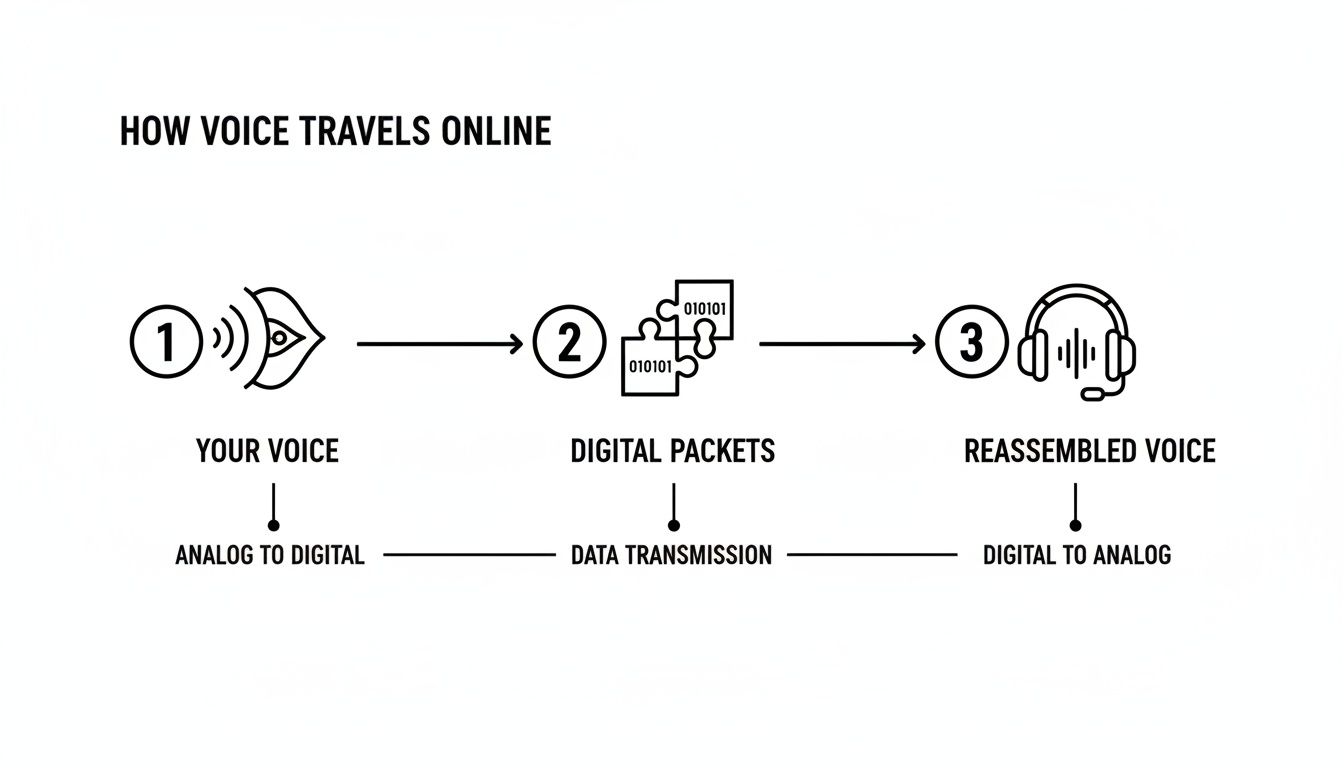
This whole process of deconstructing and reassembling your voice is what makes VoIP so nimble compared to old-school phone lines. Let's break down two of the most powerful and common types of VoIP numbers you'll encounter: Direct Inward Dialing (DID) and Toll-Free numbers.
A Direct Inward Dialing (DID) number is essentially a virtual phone number that you can point to almost anything—a specific phone line, a group of agents, or even an individual's softphone app. Think of them as unique digital front doors for your business calls.
They're perfect for things like tracking how well a specific marketing campaign is performing. For instance, you could assign a unique DID number to a local ad campaign to see exactly how many calls it generates, giving you a crystal-clear ROI. If you want to go deeper on this, you can learn more about what a DID number is in our detailed guide.
On the flip side, you have Toll-Free numbers. These are your classic 800 or 888 numbers, and they are the gold standard for creating a credible, national presence. They let customers from anywhere in the country call you without it costing them a dime, which immediately removes a big hesitation for someone to reach out.
Using a toll-free number signals that your business is established and customer-focused, making it ideal for main support lines or national sales inquiries.
A VoIP number is more than just a way to make calls over the internet. It's your ticket to a whole new level of outreach. When you understand what a VoIP number means for your business, you start to see the possibilities for marketing and sales that just aren't possible with a regular phone line.
The real showstopper here is Ringless Voicemail.
Imagine dropping a voicemail directly into someone's inbox without their phone ever making a sound. It's a non-intrusive, respectful way to deliver a message, promotion, or update without interrupting their day. We're big believers in this kind of considerate marketing. If you want a deeper dive, check out our guide on what is ringless voicemail.
Ringless voicemail lets you connect with people on their own time. It guarantees your message is there when they're ready to listen, which is why we see open rates as high as 96%.
That same VoIP number is also your command center for other powerful tools. You can send out large-scale Voice Broadcasting campaigns to thousands at once or run super-targeted SMS and MMS campaigns.
The magic isn't just in the number itself, but in the tools it connects you to. These features are built to grab attention and automate your follow-up in ways a traditional phone line simply can't.
For example, this is how a simple email you write can instantly become an SMS broadcast sent to your entire list. It's a perfect illustration of VoIP technology in action.
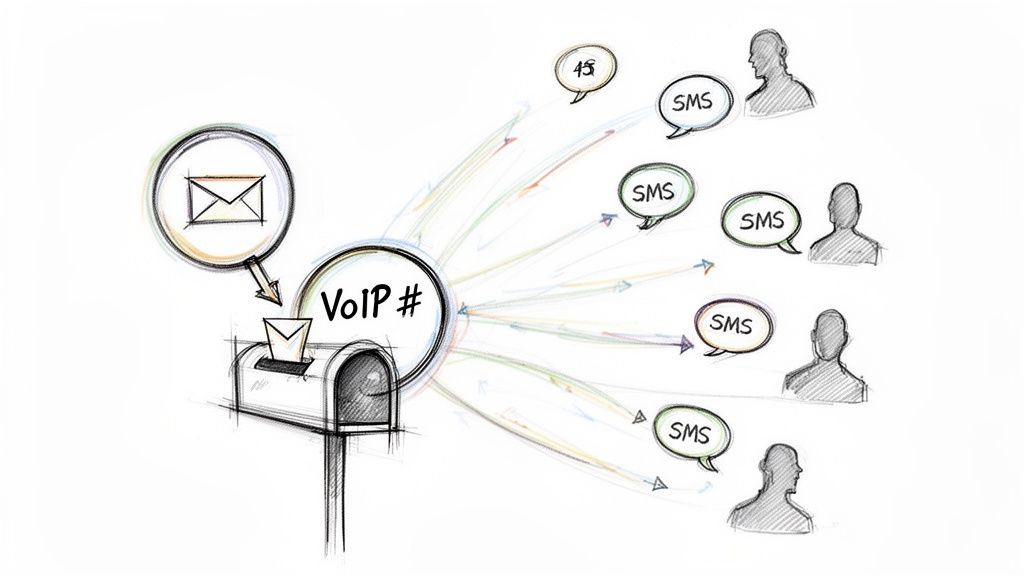
This ability to seamlessly bridge different communication channels is the core strength of a VoIP number. You can manage and automate your outreach across text, voice, and more, all from one place.
With a VoIP number from Call Loop, you can set up:
At the end of the day, a VoIP number isn’t just about getting a dial tone. It gives you a complete system for communication that can scale with your business and make your outreach far more effective.
Alright, so you’re thinking about making the switch to a VoIP number. It’s a smart move, but having a clear map for the transition makes all the difference.
While the benefits are huge, you’ve got to get the practical details right to make sure everything runs smoothly. This means thinking about everything from keeping your current number to staying on the right side of the law.
One of the first questions people ask is, "Can I keep my business number?" The good news is, you almost always can. It’s done through a process called number porting.
It’s a pretty straightforward process where your current business number is transferred from your old provider over to your new VoIP service. This way, you don't lose the business identity you've already built.
Beyond just moving your number, you have to think about compliance. This is a big one, especially if you're using your VoIP number for outreach like SMS, voice broadcasting, or ringless voicemail drops.
Following the rules set by the Telephone Consumer Protection Act (TCPA) isn't optional—it's essential. It keeps your campaigns effective and, more importantly, legal. This includes things like honoring opt-out requests immediately and keeping a solid Do Not Call (DNC) list.
For any responsible business, a VoIP number is a tool for compliant communication. Using features like built-in DNC management and clear opt-in/opt-out tools protects your brand and builds trust with your audience.
Also, remember that the quality of your VoIP service lives and dies by your internet connection. Since your calls and texts are running over the internet, a stable connection is the backbone for clear, uninterrupted communication. You can't skip this part.
If your business handles sensitive information, like in healthcare, security is another major piece of the puzzle. When you're picking a provider, look for one that supports HIPAA compliance.
This ensures any patient communication, like appointment reminders sent via ringless voicemail, is handled securely. By getting these practical details right, you can use your VoIP number to its full potential and build trust with every message you send.
So, you're thinking about moving your business phone system over to VoIP. Smart move. This isn't just some tech upgrade; it's a step toward smarter, more flexible business communication that can actually save you a ton of money.
We're talking about more than just a dial tone. You get access to powerful tools that can completely change how you connect with customers.
The proof is in the numbers. The global VoIP market is on track to hit a staggering $415.20 billion by 2034. For small and medium-sized businesses in the US, it’s already an $11.7 billion market.
This isn't just a trend; it's how modern businesses scale sales and support. Think automated SMS campaigns, ringless voicemail drops, and a whole new level of outreach, all from one system.
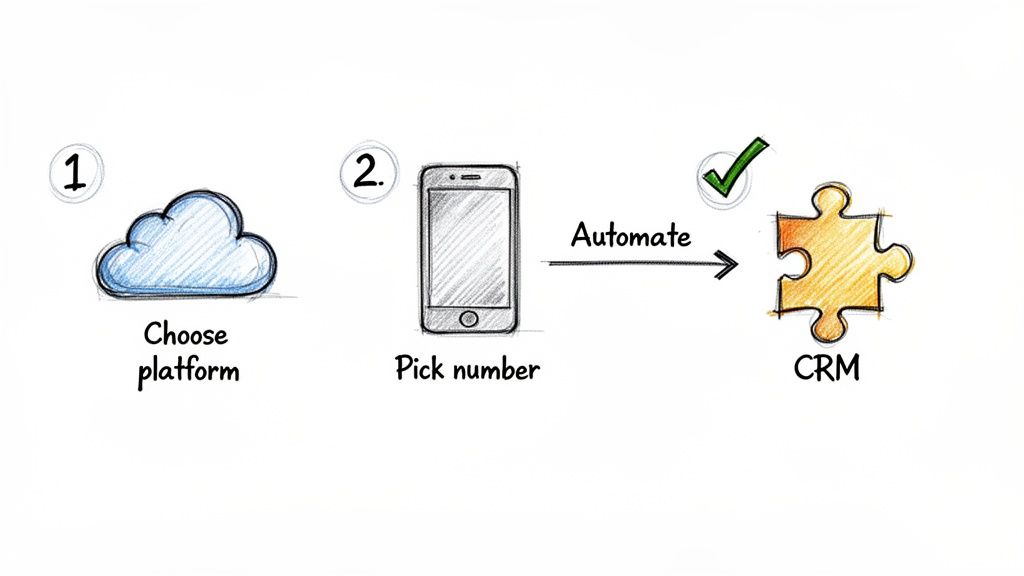
Getting up and running is more straightforward than you might think. The most important thing to remember is that a VoIP number means you’re getting an entire communication platform, not just a phone number.
Here’s a simple plan to get started:
Alright, you get the gist of what a VoIP number can do for your business. But I bet a few questions are still rattling around in your head.
Let's tackle some of the most common ones I hear from business owners.
Yes! You absolutely can. This is a huge relief for most businesses.
The process is called number porting. It’s just a technical term for moving your existing phone number from your old-school phone company over to your new VoIP provider. It ensures you don't have to change a single business card, website, or marketing flyer.
It's a fair question, and the answer is yes—if you pick the right partner. Good VoIP services use encryption to scramble your calls and keep your data private.
If you’re in an industry like healthcare, this is non-negotiable. You have to choose a platform that is HIPAA-compliant. This protects you when sending sensitive info, like an appointment reminder sent through a ringless voicemail.
Think of it this way: VoIP security is a team effort. Your provider builds the fortress, but your secure internet connection is the first line of defense.
This is one of my favorite features, and it’s a total game-changer for outreach.
A ringless voicemail drop is a clever piece of tech that sends a pre-recorded audio message straight to someone's voicemail. Their phone never even makes a peep.
It’s the perfect way to deliver a message without interrupting someone's day. Because the technology talks directly to the phone carrier's voicemail server, it’s a completely non-intrusive approach that gets your message heard.
Ready to transform your business outreach with SMS, voice, and ringless voicemail? Call Loop provides the unified platform you need to automate, personalize, and scale your communications effortlessly. Join over 45,000 users and get started today!
Chris Brisson
Chris is the co-founder and CEO at Call Loop. He is focused on marketing automation, growth hacker strategies, and creating duplicatable systems for growing a remote and bootstrapped company. Chat with him on X at @chrisbrisson


Trusted by over 45,000 people, organizations, and businesses like


