
See a Demo
You're just one step away from seeing Call Loop in action.
Enter your information below to watch a demo right now.

You're just one step away from seeing Call Loop in action.
Enter your information below to watch a demo right now.

Voice broadcasting is a mass communication method that sends a single pre-recorded or text-to-speech message to hundreds or thousands of phone numbers at once through an automated dialer. It's what a busy owner reaches for when a schedule change, payment reminder, or promotion needs to reach a long list fast without hiring a call center.
A bakery owner with five thousand customers doesn't have time to call each person before a weekend rush. A school office can't manually notify every parent about an early closure either, which is why voice broadcasting still matters as a practical outbound channel.
A small business owner usually meets voice broadcasting at the point where manual calling stops making sense. The list is too long, the deadline is too close, and the message is simple enough that every recipient can hear the same instructions without a live back-and-forth.
Voice broadcasting sends one recorded message, or a text-to-speech message, to a large contact list through an automated dialer. That makes it useful for announcements, reminders, and promotions that need to reach many people quickly. The approach has been around for decades, and it grew out of the shift from basic robocalling toward more organized automated outreach. A general overview of how these systems fit into broader alerting workflows is available in mass notification systems in practice.
The appeal is straightforward. A spoken message can feel more immediate than an email subject line, and a well-written recording often sounds more personal than a generic blast.
Businesses use it when timing matters, when recipients may not check email quickly, or when hearing the message reduces confusion. That includes community notices, appointment reminders, limited-time offers, and urgent operational updates.
Practical rule: if the message would be awkward to send one by one, but still needs a human-sounding touch, voice broadcasting deserves a look.
The commercial side of this channel is also growing. One market report estimates the global voice broadcast service market at about USD 1.6 billion in 2024 and projects it to reach USD 3.3 billion by 2033, with a projected CAGR of roughly 9% from 2026 to 2033 Verified Market Reports. Other market summaries point to a broader range of estimates and continued growth through 2033, which suggests that automated voice is no longer a fringe tool. Those figures do not tell you how to run a campaign, but they do show why more teams are treating voice broadcasting as a standard part of outbound communication.
Think of a voice broadcast platform like an assembly line built for phone calls. One stage prepares the list, another dials, another plays audio, and another decides what to do when a person answers, a machine picks up, or the call fails.
The technical stack is more structured than many people expect. In a typical setup, the system uploads a contact list, segments it, and then a dialer initiates high-volume outbound calls while a media server delivers either prerecorded audio or text-to-speech content. Microsoft's old telephony architecture documentation describes the same basic pattern, with dialing, media playback, answering-machine detection, and call-control logic working together rather than as one monolithic voice process Microsoft telephony architecture).
A recipient's call path usually follows a sequence like this:
That disposition layer is the part many business owners never see, but it's the difference between “we sent 10,000 calls” and “we know which calls connected, which ones failed, and which ones should never be retried.”
Answering-machine detection is a practical safeguard, not a gimmick. If the system misreads voicemail as a live answer, it can chop off the message or create a bad experience. If it misreads a human as voicemail, it can reduce the chance of engagement.
The better systems separate signaling, media playback, and call state so they can make those decisions at scale without turning every call into a manual event.
That's also why interactive calls sometimes let a recipient press a key, usually through DTMF tones, to reach a live agent. The platform is designed to manage that response path instead of treating every call as a dead-end broadcast.
Not every voice campaign should sound the same. The format you choose shapes how much staff time you need, how quickly you can launch, and how conversational the interaction feels.
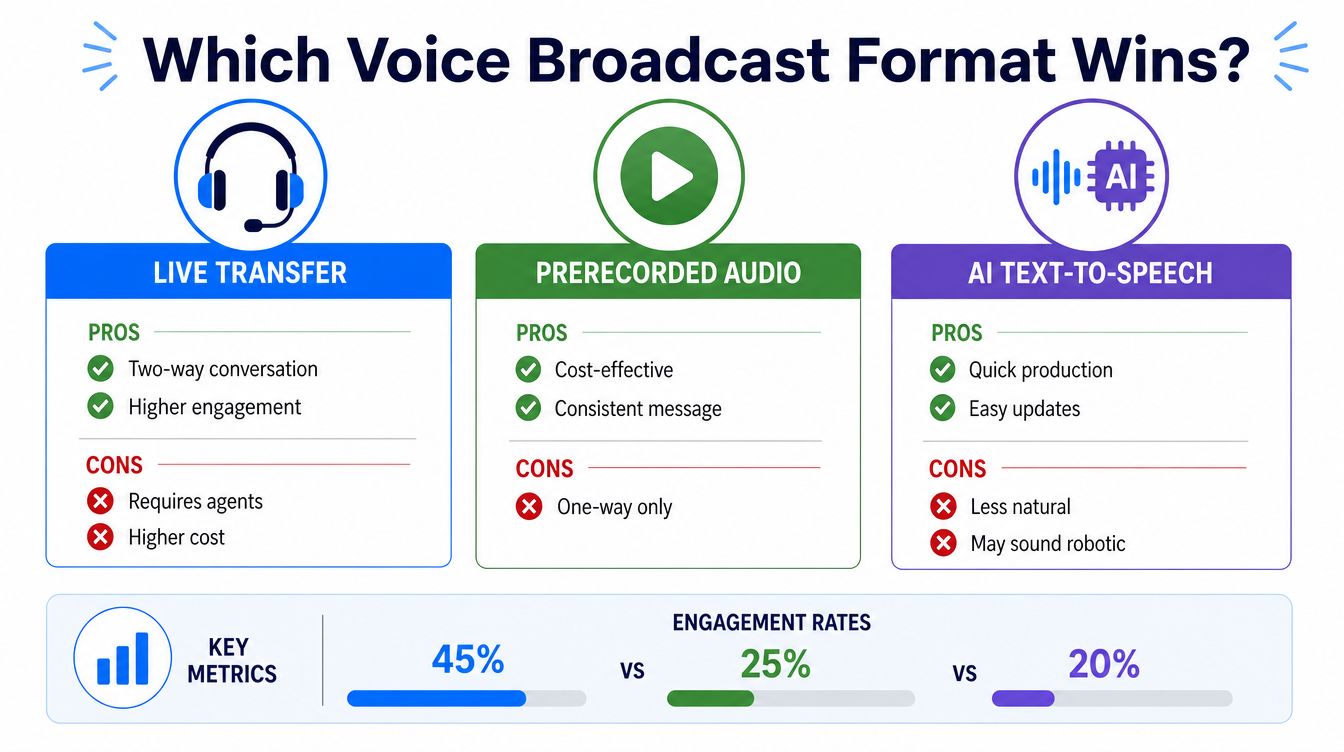
Live transfer is the most interactive option. A recipient hears the prompt and presses a key to connect with a real person, which works well when the lead is valuable or the next step needs explanation. The trade-off is obvious, it needs agents on standby and usually costs more to run because the human follow-up is part of the model.
Prerrecorded audio is the simplest version of voice broadcasting. A person records the message once, the platform sends it many times, and every recipient hears the same phrasing, which makes it useful for announcements, reminders, and time-sensitive updates. It's cost-effective and consistent, but it's still a one-way message, so it won't carry the same back-and-forth value as a live handoff.
AI text-to-speech sits between speed and flexibility. Teams can revise the script without re-recording, which helps when offers change or when the same campaign needs small wording updates across segments. The downside is tone, because synthetic delivery can still sound a little robotic if the script isn't written for speech.
If you're comparing voice output to other content workflows, best AI voice for TikTok videos is a useful read for understanding how TTS quality changes depending on use case.
| Format | Strength | Weak point | Best fit |
|---|---|---|---|
| Live transfer | Two-way conversation | Requires agents | High-value sales and support routing |
| Prerecorded audio | Consistent message | One-way only | Alerts, reminders, promotions |
| AI text-to-speech | Fast updates | May sound robotic | Rapid testing and frequent script changes |
The format choice should follow the campaign goal, not the other way around. If you need a short, direct message to go out fast, prerecorded or text-to-speech usually wins. If the next step is a sale conversation, live transfer is the better fit.
Voice broadcasting shows up in more places than most owners expect. The underlying pattern stays the same, but the reason for using it changes by industry.
Healthcare providers use voice broadcasts for appointment reminders, follow-ups, and prescription-related notices. The main challenge is keeping messages clear and limited to permitted information, because patient privacy and workflow discipline matter more than campaign flair.
Ecommerce teams use them for product launches, shipping updates, and limited-time promotions. A broadcast works well when customers need the same short update at the same time, especially if the message complements order communication rather than replacing it.
Event organizers rely on voice outreach for venue changes, check-in reminders, and last-minute schedule shifts. Schools and training providers use it for closures, parent notices, and attendance-related reminders, where a spoken call can cut through the noise faster than an inbox.
Sales teams use voice broadcasts to invite prospects to webinars, re-engage dormant leads, and push timely follow-up prompts. Customer success teams also use them for service notices and reminders, especially when a missed appointment creates avoidable churn.
The pattern is consistent. Each industry uses the same automation layer, but the message, timing, and compliance rules change with the context.
Operational insight: the best use cases usually share one trait, the message is short, timely, and easy to act on without a long back-and-forth.
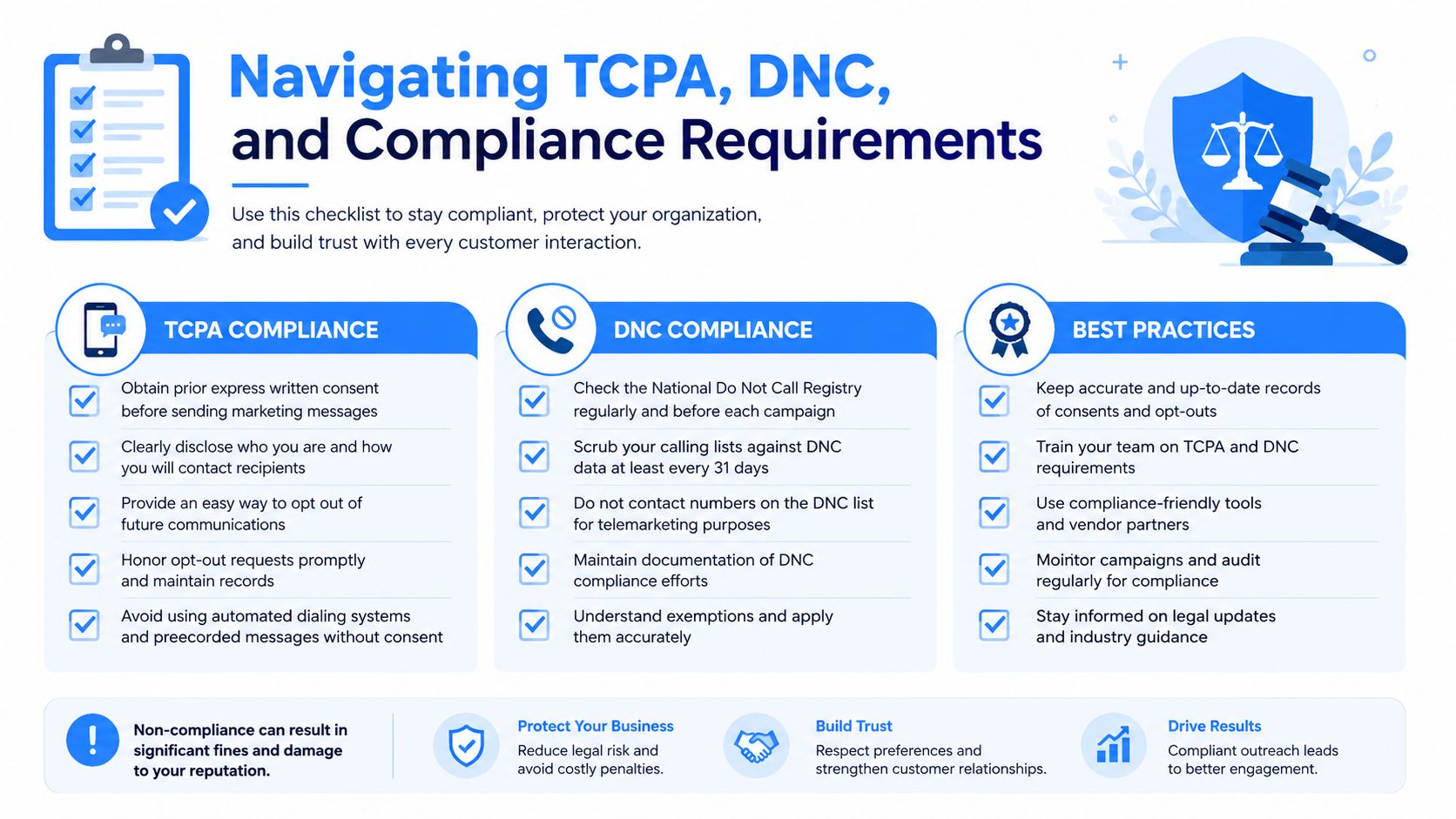
A voice broadcast can look like a simple batch of calls from the outside. Inside the system, it behaves more like a controlled routing job, because every number has to clear consent rules, suppression checks, caller identification, and opt-out handling before it becomes a deliverable contact. If those pieces are weak, the campaign stops being a marketing asset and starts creating exposure.
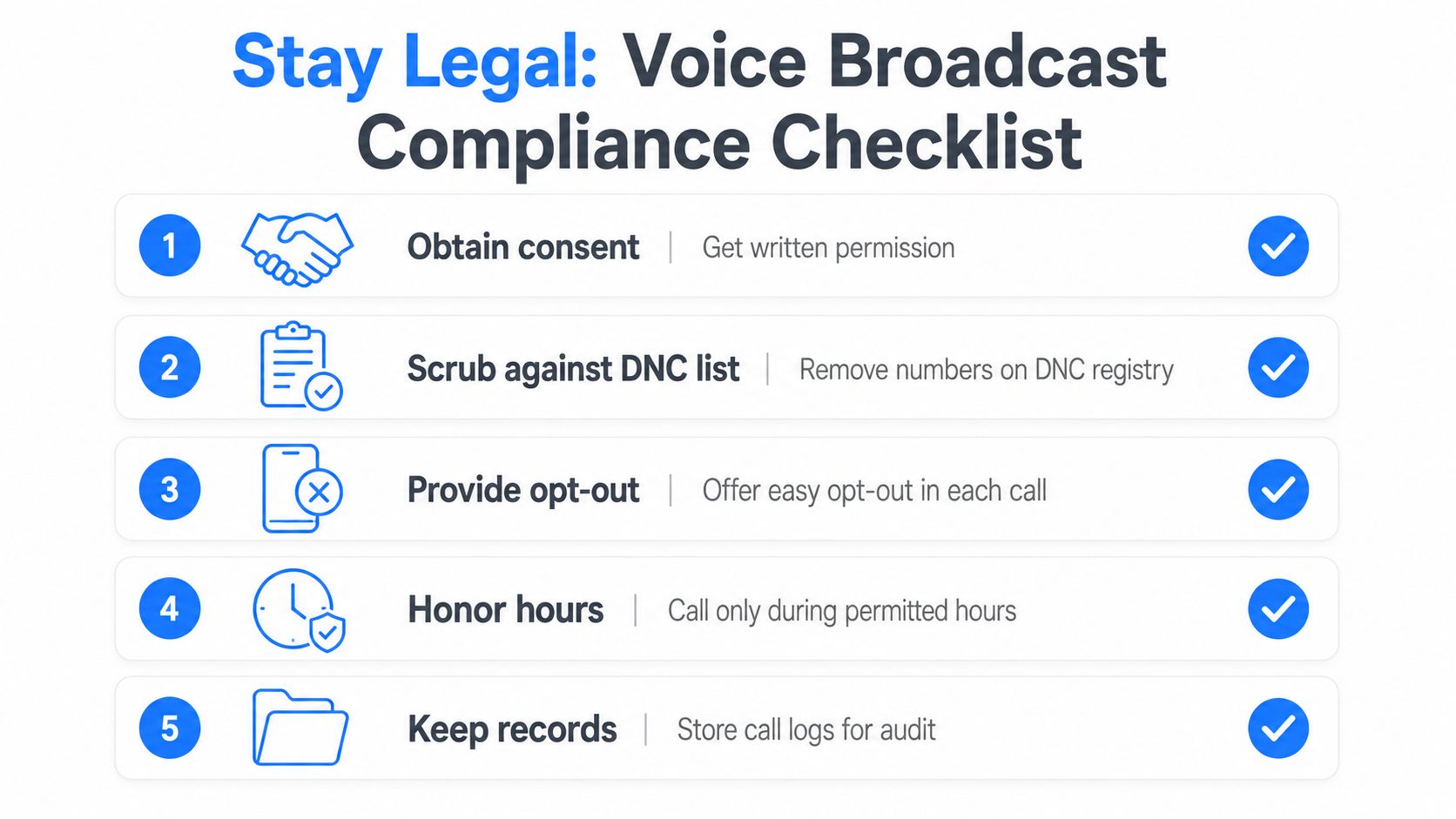
A neutral glossary source notes that voice broadcasting is legal only with proper consent, and that it can become illegal without prior express written consent, on DNC numbers, outside permitted hours, or without identification and opt-out mechanisms DialPhone voice broadcasting glossary. That is why compliance has to be part of the campaign design from the start, the same way list hygiene and retry logic are part of deliverability.
For automated marketing calls, consent is not a box to check after the upload. Promotional outreach needs permission that matches the channel and the message, because a prior customer interaction does not automatically cover every new broadcast. DNC scrubbing works the same way. If a number sits on a suppression list, the dialer should treat it like a closed door even if the CRM still shows it as active.
Timing matters too. A call placed at the wrong hour can turn a permitted message into a complaint, and missing identification or opt-out language can create the same problem even when the content itself is routine. That is why campaign operators need to think about consent, calling windows, and message framing together, not as separate tasks.
For a practical workflow reference, the guide to TCPA for marketing teams helps map consent handling to day-to-day outreach. For platform setup and consent process checks, Call Loop's TCPA compliance checklist gives a useful reference point.
Good compliance hygiene is mostly recordkeeping. Keep proof of consent, keep records of opt-outs, and keep a log of what was sent and when it was sent.
If you cannot show why a number was called, you are relying on memory instead of a defensible process.
For healthcare teams, the compliance bar is higher because privacy rules shape what can be said and how it can be delivered. Tools that combine DNC management with double opt-in workflows can reduce manual mistakes, but the sender still carries the responsibility for keeping the message within the right bounds.
A voice campaign can send cleanly and still miss its mark. The useful numbers live in the disposition report, where each call is classified by what happened after dialing.
Disposition reporting shows whether a call reached a live person, hit voicemail, transferred, failed, returned a busy signal, or landed on an invalid number. That matters because reach alone does not explain quality, and a campaign built on the wrong mix of answers can look busy while producing little actual contact.
Those labels are more than report fields. They are the operational trail that helps you separate a bad list from a bad schedule, or a working script from a weak handoff.
Modern voice systems also depend on a streaming pipeline rather than a single slow voice process, because overlapping stages can reduce latency and improve how quickly the system responds, as described in the arXiv technical analysis. In practice, that matters because a slower response can make an interactive call feel clumsy right after someone answers, which can hurt engagement before the message even gets going.
Retry logic helps only when it is controlled. If unanswered calls are hammered again and again, the campaign starts to feel careless, especially when the same person keeps seeing the same number. Time-zone-aware scheduling matters for the same reason, because a list that performs acceptably at one hour can look very different when the call lands at a poor hour.
The goal is to read the call pattern, not just the total volume. A campaign can produce plenty of activity and still tell you very little about what should change next. For a closer look at how to interpret that data, campaign performance analytics is a useful reference point.
Useful benchmark mindset: if a campaign produces lots of call volume but little useful disposition detail, the reporting is too shallow to guide better outreach.
The cleanest voice campaigns start before the first call goes out. Good deliverability comes from list hygiene, message discipline, and a delivery sequence that respects how people respond.
Validate numbers before upload, segment by audience type, and separate promotional contacts from informational ones. That reduces invalid calls, keeps messages relevant, and helps you avoid sending the same script to people who need different context.
A voice script should sound natural when spoken aloud, not read like a flyer. Short sentences work better, the ask should come early, and the recipient should know who is calling before the message drifts into detail.
Send at hours that make sense for the audience, then keep retry logic limited and purposeful. A second attempt can recover a missed contact, but repeated attempts can feel careless fast, especially when the same person already ignored the first call.
Voice broadcasting also works better when it's part of a broader sequence. Many teams combine it with SMS for initial reach and with ringless voicemail for a follow-up touch that lands in the inbox without ringing the phone. That sequence gives you more than one chance to connect without forcing the same channel to do every job.
Call Loop is one platform that combines voice broadcasting, SMS, and ringless voicemail in one workflow, with live and machine answer detection, press-1 transfers, recorded or AI text-to-speech audio, and DNC management. It's one option for teams that want those outbound pieces in a single place.
The strongest campaigns don't rely on one channel to carry the whole relationship, they sequence channels so each one does what it's best at.
If you're planning your next outreach push, start with the message, then map the call logic, consent, and follow-up path before you upload a list. If you want a platform that can handle voice broadcasting alongside SMS and ringless voicemail, visit Call Loop and review how its outbound tools fit your campaign process.
Chris Brisson
Chris is the co-founder and CEO at Call Loop. He is focused on marketing automation, growth hacker strategies, and creating duplicatable systems for growing a remote and bootstrapped company. Chat with him on X at @chrisbrisson


Trusted by over 45,000 people, organizations, and businesses like


