
See a Demo
You're just one step away from seeing Call Loop in action.
Enter your information below to watch a demo right now.

You're just one step away from seeing Call Loop in action.
Enter your information below to watch a demo right now.


Most outbound campaigns fail for a simple reason. They treat everyone like the same buyer.
That approach is expensive now. Market segmentation drives a critical 80% conversion advantage because 80% of audiences tend to do business with a brand that personalizes their experience according to NVecta's segmentation statistics roundup. If your SMS blasts, voice drops, and ringless voicemail campaigns all sound generic, you're not just missing a branding opportunity. You're leaving revenue on the table.
Small businesses feel this faster than large ones. You don't have room to waste budget sending the same message to cold leads, repeat buyers, inactive contacts, local customers, and people who only opted in for reminders. Each group responds to different timing, different offers, and sometimes different channels. A text that works for a flash sale might be the wrong move for a patient reminder. A ringless voicemail that gets a callback from an older local audience might annoy a segment that prefers a short SMS with a link.
Segmentation fixes that. It turns one oversized list into smaller groups you can market to with relevance. That changes the math on outreach. Messages get sharper. Follow-up gets easier to automate. Compliance gets easier to manage because you're not pushing the wrong content to the wrong contacts.
That's the practical answer to why market segmentation is important. It helps you sell more without increasing noise.
Generic outreach feels efficient because it's easy to launch. Pull a list, write one message, hit send. The problem is that convenience on your side creates friction on the customer's side.
People ignore messages that don't match their situation. A first-time lead doesn't need the same SMS as a returning customer. Someone who clicked an appointment reminder shouldn't get the same voice broadcast as someone who hasn't engaged in months. When businesses skip segmentation, they send broad messages that blur together and get deleted, ignored, or blocked.
Segmentation matters because personalization doesn't begin with writing copy. It begins with deciding who should receive what.
If you run outbound campaigns, this shows up in obvious places:
Practical rule: If one campaign could be sent to your entire list with no edits, it's probably too broad.
Segmentation also protects your brand. Relevance isn't only about conversion. It affects whether people keep reading your messages at all. Repeatedly sending mismatched outreach trains subscribers to tune you out.
Outbound messaging is interruptive by nature. You're entering someone's inbox, notification feed, or voicemail box. That means relevance has to be earned quickly.
Segmentation is how you do that. You group customers by meaningful traits, then match the message, timing, and channel to those traits. That's what turns outbound from interruption into utility. A reminder arrives when it helps. A follow-up lands when intent is still warm. A ringless voicemail sounds like a continuation of a conversation instead of a random drop.
That's why businesses that segment don't just send less noise. They build campaigns that have a reason to exist.
The reason to segment isn't academic. It's financial.
Market segmentation directly improves marketing efficiency by reducing wasted resources. A targeted approach ensures messages reach the most receptive audiences, which lowers Customer Acquisition Cost and increases conversion rates per segment. Segmenting by behavior and demographics also helps teams allocate resources more efficiently, resulting in higher engagement rates and improved Customer Lifetime Value, as explained in Adobe's overview of market segmentation.
That sounds strategic, but the impact is very practical for a small business owner.
Every outbound campaign has a cost. Even when the per-message cost is low, waste compounds fast when you send the wrong message to the wrong people.
Segmentation cuts that waste in three places:
| Area | Unsegmented approach | Segmented approach |
|---|---|---|
| Audience | Everyone gets the same campaign | Only relevant contacts receive it |
| Offer | One generic promotion | Offer matches need, stage, or behavior |
| Follow-up | Same reminder cadence for all | Different timing by intent and activity |
If a contact only signed up for appointment reminders, they shouldn't be dumped into your promotional sequence. If someone already bought, don't spend acquisition budget marketing the same entry offer again. If a lead requested pricing, they need a different follow-up path than someone who downloaded a general guide.
A lot of businesses mistake activity for performance. More sends, more calls, more broadcasts, more automation. None of that matters if the wrong people are receiving them.
Segmentation improves the quality of response because the campaign aligns with intent. That usually means:
The cheapest message to send is the one you never should have sent.
Profit becomes evident. When you stop spending on people who were unlikely to buy, your budget works harder on segments worth pursuing.
Most small businesses don't suffer from a lack of ideas. They suffer from too many ideas and not enough capacity. Segmentation helps you decide where to focus.
You can prioritize the groups most likely to respond, the customers most likely to return, or the accounts most likely to need a call instead of a text. That makes campaign planning simpler. It also keeps your team from treating all contacts as equal when they clearly aren't.
Good segmentation doesn't just improve marketing. It improves decision-making. You stop asking, “What should we send this week?” and start asking, “Which segment has the clearest reason to hear from us right now?”
Most segmentation strategies start with four core lenses. You don't need to use all four at once, but you should know what each one does and where it fits.
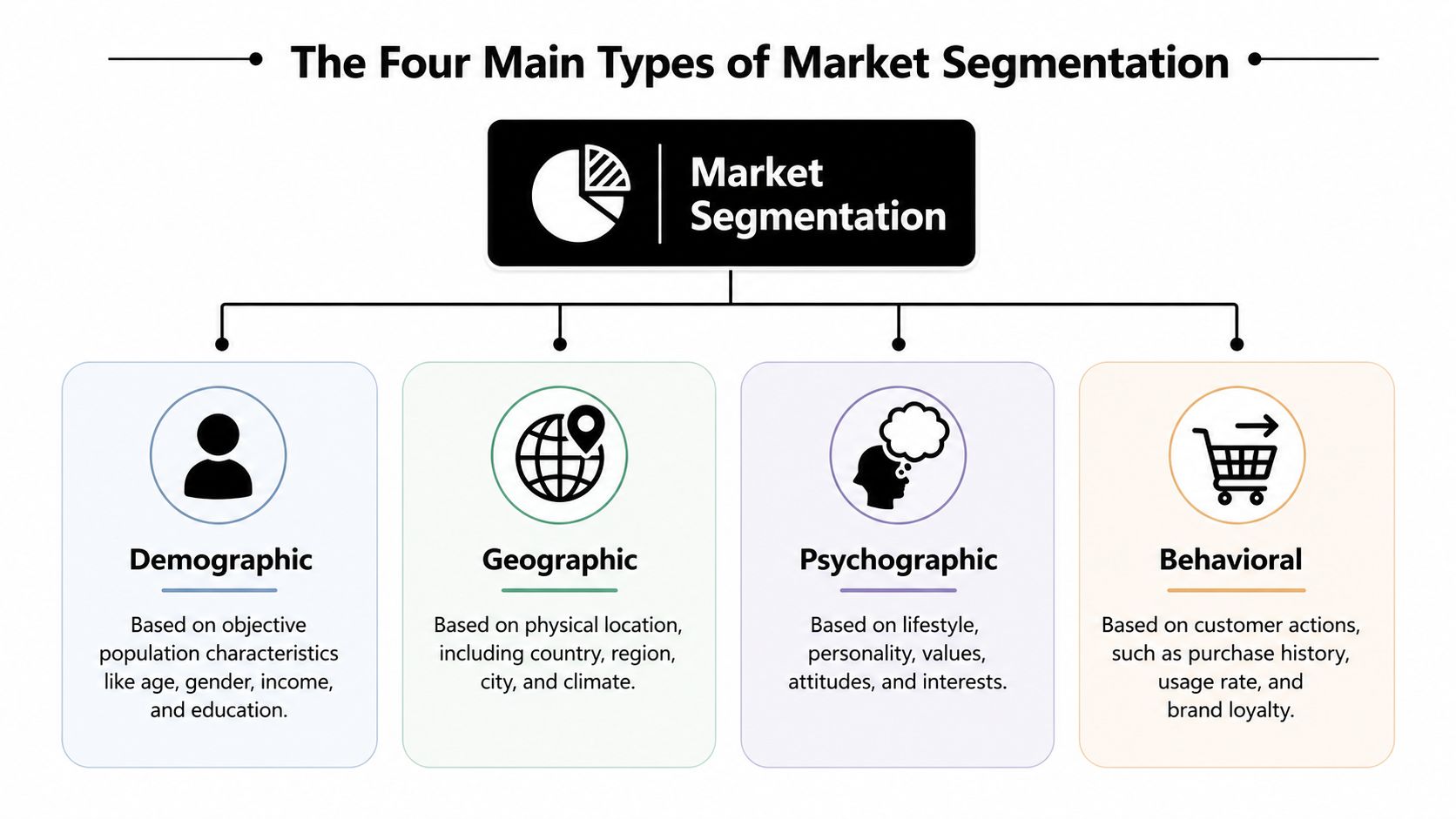
This is the most familiar type. It groups people by objective traits such as age, income, gender, family status, or occupation.
For outbound messaging, demographic segmentation works best when the offer clearly connects to life stage or purchasing ability. A family-focused service might send one SMS sequence to parents and another to single professionals. A high-ticket service might separate budget-conscious leads from premium buyers before any sales calls go out.
Demographics are useful, but they rarely tell the full story. They tell you who the customer is, not necessarily why they act.
Geographic segmentation uses location. Country, state, city, neighborhood, service radius, even climate can matter depending on the business.
This is one of the easiest wins in outbound. If you host in-person events, manage local appointments, or run area-specific promotions, location should shape your campaign by default.
A few strong use cases:
Geography also matters for timing. Sending at the wrong local hour can ruin a good campaign.
Psychographics focus on lifestyle, values, interests, and attitudes. This is softer data, but it often creates stronger messaging.
If two customers buy the same product for different reasons, psychographic segmentation helps you speak to those differences. One buyer may care about convenience. Another may care about status, privacy, or simplicity.
For outbound campaigns, this changes tone and framing more than channel mechanics. The message itself becomes more persuasive because it matches motivation.
When customers buy for different reasons, one message won't persuade all of them.
Behavioral segmentation is often the most actionable because it uses what people do. Site visits, clicks, repeat purchases, signups, missed appointments, abandoned carts, keyword opt-ins, and prior responses all belong here.
That's why it maps so well to SMS, voice, and ringless voicemail. You can trigger outreach based on actions instead of assumptions. Someone who clicked a pricing link can receive a follow-up voice message. Someone who joined via a text keyword can enter a customized SMS drip. Someone who abandoned a cart can get a reminder sequence that fits that exact behavior.
If you want a practical outside definition, RealEstateCRM defines behavioral segmentation in a way that's useful beyond real estate because it focuses on observable actions, not guesswork.
The strongest segmentation rarely comes from one category alone. It comes from layering them.
A local clinic might use geographic plus behavioral data. An ecommerce brand might combine demographic and purchase behavior. A B2B team might start with company profile details, then refine by engagement signals.
That lines up with a broader point from Number Analytics on segmentation methods, which notes that impactful approaches include cluster analysis for grouping customers based on shared traits and behavioral segmentation for aligning marketing with actual customer actions, alongside predictive analytics and AI-driven segmentation for adapting to changing conditions.
The lesson is simple. Start with a clean category. Then add another layer only when it makes the campaign more useful.
Theory gets clearer when you see how segmentation changes actual campaigns.
An online store shouldn't treat every subscriber like a new lead. A shopper who bought last month needs a different message than someone who viewed products but never checked out.
A practical setup looks like this:
The key is that the outreach reflects the customer's last action. Behavioral segments make that possible. Generic “buy now” blasts don't.
In B2B outbound, firm size and industry matter. But they're often not enough. Technology stack can tell you whether a prospect is even compatible with your offer.
According to Metadata's explanation of technographic segmentation, technographic segmentation provides a technical specification for identifying prospects with compatible technology stacks, enabling more relevant messaging that addresses specific integration needs. In practice, that helps teams find underserved markets and makes multi-channel outreach more relevant, including AI text-to-speech or ringless voicemail sequences that align with the prospect's existing CRM.
That means a B2B team can segment by platform fit before outreach starts. If one prospect uses a stack your service integrates with, they get a message centered on workflow compatibility. If another would need extra setup, the message changes or the account gets deprioritized.
If your team is sorting out channel strategy as well as list strategy, this guide on understanding inbound and outbound sales is useful because it clarifies when proactive outreach makes sense and when it doesn't.
Healthcare outreach is where sloppy segmentation becomes risky fast. Patients who opted in for reminders should be separated from patients receiving general updates. Different offices, providers, and appointment types should also be segmented so messages stay relevant and compliant.
In this kind of setup, one platform can help if it supports audience segmentation, scheduling, double opt-in controls, and HIPAA-aware workflows. Call Loop's customer segmentation examples show the kinds of audience splits that make outbound easier to organize across messaging campaigns.
A simple healthcare example might include:
| Segment | Channel | Message type |
|---|---|---|
| Upcoming appointments | SMS | Reminder with confirmation prompt |
| No-show follow-up | Voice | Reschedule prompt |
| Prescription refill window | Ringless voicemail | Timely reminder |
| General wellness subscribers | SMS | Educational or seasonal update |
A local service business often has a mixed database. New inquiries, old estimates, active customers, and overdue follow-ups all live in the same contact pool. If you send one campaign to all of them, it won't feel relevant to any of them.
Segmentation lets you send a quote follow-up by SMS to recent inquiries, a ringless voicemail reminder to older estimates that still have value, and a customer care voice broadcast to existing clients during seasonal demand periods.
That's where outbound starts acting like a system instead of a series of one-off sends.
Most businesses don't need a complicated segmentation model to get started. They need a usable one.

Don't begin with data fields. Begin with the decision you're trying to improve.
Good starting goals include:
One goal forces focus. If you try to segment for every department at once, you'll build a messy structure nobody uses.
Most small businesses already own more segmentation data than they think. The issue is that it's scattered.
Look at:
If you need help thinking through research inputs before you build segments, 10Seat's market research strategies offer a practical reminder that useful segmentation starts with real customer signals, not assumptions. The examples come from restaurants, but the research logic applies broadly.
A segment is only useful if it changes what you send, when you send it, or which channel you use.
That means your first segments should be operational, not decorative. “Women age 25 to 44” may be interesting, but “requested pricing in the last week” is immediately actionable. So is “joined via webinar keyword” or “missed last appointment.”
Build segments you can message differently, not segments that only look good in a spreadsheet.
This is also where AI can help. If your tools surface patterns in response behavior or customer traits, they can help you identify which segments deserve different treatment. AI-driven customer insights are especially useful when your list is large enough that manual sorting starts breaking down.
A first rollout doesn't need ten branches. Two or three strong paths are enough.
Try a model like this:
That structure is easy to maintain and easy to measure.
Segmentation isn't “set it and forget it.” Customers move. Lists age. Offers change.
Review whether your segments are still distinct and whether each one receives a genuinely different campaign. If two segments behave the same and receive the same messaging, merge them. If one segment keeps showing unusual response patterns, split it carefully and test a new message path.
The goal isn't complexity. The goal is control.
A lot of businesses get excited about segmentation, create a maze of lists, and then make performance worse.

More segments don't automatically mean better targeting. Sometimes they mean weaker data, smaller audiences, and muddier campaigns.
That risk is no longer theoretical. Industry data indicates that 38% of mid-sized businesses now create 10+ segments, yet campaigns targeting segments under 5,000 users show 22% lower conversion rates because of diluted messaging and higher cost per acquisition, according to Adobe's discussion of market segmentation risks.
If a segment becomes too small, you may not have enough signal to know whether the campaign works. You also create more operational overhead for your team.
A segment can look detailed and still be wrong. That happens when businesses rely on stale tags, incomplete fields, or outdated customer status.
A few examples:
False precision is dangerous because it feels refined. In practice, it creates irrelevant outreach and compliance problems.
Some teams do the hard work of defining segments and then keep sending generic campaigns anyway. That's common when the CRM and messaging workflow aren't connected, or when nobody owns the campaign logic.
Use this quick check:
| Warning sign | What it usually means |
|---|---|
| Same copy goes to every segment | Segmentation exists on paper only |
| No channel rules by segment | You're not matching audience to format |
| No opt-in separation | Compliance risk is creeping in |
| No review cycle | Segments are aging without oversight |
Good segmentation reduces noise. Bad segmentation just organizes it.
For SMS, voice, and ringless voicemail, that last point matters a lot. The channel is direct. Mistakes are visible. If your segments don't improve relevance, simplify them until they do.
Once segmentation is live, track performance by segment, not just by campaign total. That's how you learn whether your structure is helping or just adding complexity.
Useful measures include:
The point isn't to build a massive dashboard. It's to see whether each audience group responds better when the message matches its needs and behavior.
A simple rule works well. If a segment gets unique messaging, it should earn unique reporting. If you can't measure it separately, you probably won't improve it.
For a practical framework on evaluating campaign performance, this guide to measuring marketing campaign effectiveness is a useful next read.
Why is market segmentation important? Because outbound only works when relevance is built into the system. Segmentation improves who you contact, what you send, when you send it, and which channel you use. That leads to cleaner execution, lower waste, stronger compliance habits, and better odds of turning attention into revenue.
If you're running SMS, voice, or ringless voicemail campaigns and want a cleaner way to organize segments, automate follow-up, and keep outreach aligned with customer behavior, Call Loop is one platform built for that kind of multi-channel workflow.
Chris Brisson
Chris is the co-founder and CEO at Call Loop. He is focused on marketing automation, growth hacker strategies, and creating duplicatable systems for growing a remote and bootstrapped company. Chat with him on X at @chrisbrisson


Trusted by over 45,000 people, organizations, and businesses like


